MSSP Maturity: Breaking the Level 2 Partnership Plateau

A Successful MSSP Partnership Isn't Static
Security and IT leaders face growing pressure to detect and respond to threats while building resilience across complex environments—without sacrificing speed, efficiency, or trust. Managed Security Service Providers (MSSPs) sit at the center of that effort for many organizations. However, a successful partnership isn't a static, one-size-fits-all engagement. It is a journey that evolves as your business grows.
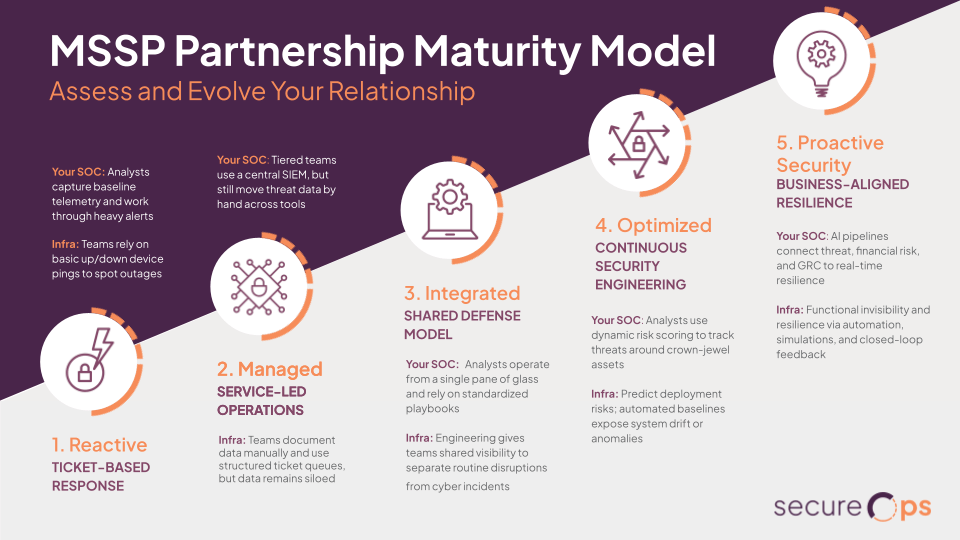
True cyber resilience requires looking at your security operations through a dual lens. The SecureOps MSSP Partnership Maturity Model tracks how your Security Operations Center (SOC) capabilities and Infrastructure Security evolve in tandem across five distinct levels. This paves the way for bridging the traditional gap between internal IT operations and security teams.
Our Model for MSSP Partnership Maturity
Traditional security roadmaps often look at technical operations in a vacuum. To give you a more realistic view, our framework combines the operational scales of SecureOps' SOC Maturity Cyber Resilience Framework and Infrastructure Maturity Operational Resilience Framework with strategic security principles. This model tracks your movement as you advance from reactive prevention to proactive cyber resilience.
By mapping your progress against the twin domains of the SOC and Infrastructure, the matrix serves as a practical roadmap. It helps you pinpoint exactly where your operations stand today so you can intentionally build a strategic partnership.
Level 1: Reactive (Ticket-Based Response)
At Level 1, operations are purely reactive and trapped in a cycle of crisis management. Organizations find themselves flooded by disconnected alerts, treating their MSSP as a ticket generator rather than a partner. Because they rely on static rules that fail to keep pace with the threat landscape, teams are constantly looking at past incidents.
Boutique MSSPs differentiate here by cutting through this noise. Instead of letting internal teams drown in the abstract, highly standardized alert queues typical of large-scale providers, they embed more closely with internal teams to manually tune out false positives and tailor detection and response to specific environments.
-
SOC focus: Analysts face an overwhelming volume of alerts generated by a limited, non-optimized variety of log sources. Without advanced correlation, they focus on chasing individual, static behavioral flags and spot compromises after the fact.
-
Infrastructure focus: Visibility is limited to basic up/down device pings and perimeter logs, leaving significant blind spots across the environment. When disruptions happen, teams rely on fragmented, manual troubleshooting to restore systems.
Attributes
-
The MSSP analyzes logs, generates alerts, and opens tickets when something suspicious appears. Internal teams often experience alert fatigue.
-
Communication flows through support queues rather than structured collaboration. Reporting focuses on uptime and incident counts, not security posture.
-
Ownership remains unclear. The MSSP observes activity but lacks the internal context to contain it. The task falls on internal IT and security teams that waste critical time manually correlating alerts across disconnected systems.
Why move on
Modern threat actors move faster than reactive processes can respond. In many environments, attackers move from reconnaissance to full access and data exfiltration in under an hour. A model built on manual ticket queues creates a dangerous delay between detection and action. By the time teams engage, the damage has often spread. This urgency is compounded by AI-enhanced ransomware reshaping MSSP defense models, where automated attack chains compress attacker timelines even further and demand a fundamentally different defensive posture.
Example scenario
An MSSP detects suspicious login behavior at 2:00 AM, generates an alert, and routes it to a ticketing system. Internal teams review it hours later. By that point, the attacker has already moved laterally across systems and extracted sensitive data.
Steps to mature
-
Establish baseline asset visibility across environments.
-
Define clear ownership for detection, escalation, and containment.
-
Confirm exactly what the MSSP monitors and how coverage is validated.
-
Set consistent communication cadences between internal teams and the MSSP.
-
Replace assumption-based operations with documented processes and proactive confirmations.
Level 2: Managed (Service-Led Operations)
As the partnership matures, the engagement is operational rather than outcome-driven. For organizations beginning to outgrow basic MSSP arrangements, this is also the stage where evaluating MDR providers beyond MSSP basics becomes a critical strategic consideration. Understanding what a collaborative MDR partnership entails helps organizations set the right expectations before making that transition.
The focus shifts from ad-hoc firefighting to predictable execution, introducing rigid operational structures, documented playbooks, and formalized Service Level Agreements (SLAs).
-
SOC focus: Managers organize analysts into clear tiers and normalize logs within a centralized SIEM, though teams still manually copy indicators across separate toolsets to investigate recurring alerts.
-
Infrastructure focus: Engineering teams track local configurations in manual spreadsheets and log resource usage through structured ticket queues, keeping data documented but fragmented across separate consoles.
Attributes
-
SLAs define response expectations. Roles and responsibilities are documented through Responsible, Accountable, Consulted, and Informed (RACI) models.
-
The MSSP delivers consistent monitoring, reporting, and operational support.
-
Security operations become predictable, with incidents following established workflows and monthly reports summarizing activity and compliance status.
Why move on
Consistency does not equal resilience. Managed environments are backward-looking and structurally rigid and focused on reporting. Organizations can meet every SLA requirement on paper while still highly vulnerable to evolving threats because their operational metrics are divorced from risk reduction. This rigidity creates friction, leaving IT teams patching systems on fixed schedules while security teams chase active exploits. For organizations recognizing these symptoms in their current provider relationship, navigating the MSSP switchover and maturity reset outlines how to manage the transition without losing ground.
Example scenario
The MSSP identifies a critical, unpatched vulnerability on an internet-facing server and issues an urgent alert. The internal IT team acknowledges the alert within their 15-minute SLA but because they work on a rigid schedule, they queue the patch for their standard weekend maintenance cycle. Over the next two days, attackers continue targeting the same vulnerability, triggering a flood of security alerts. The MSSP closes each one because basic endpoint defense blocks the initial attempts. Because the internal and MSSP teams are focused on their siloed queues, no one realizes an attacker is actively testing the perimeter until a refined exploit bypasses the defense.
Steps to mature
-
Review SLA performance and operational metrics against real incident outcomes to ensure they reflect actual security effectiveness.
-
Integrate asset management data (CMDB) into shared IT and security ticketing queues to establish baseline visibility.
-
Map detection coverage to known threat frameworks.
-
Begin using threat intelligence to inform defense strategies and baseline active coverage.
-
Implement shared incident playbooks, automated workflows, and tabletop exercises.
-
Establish quarterly business reviews that align MSSP activity with defined threat and risk scenarios.
-
Define clear escalation paths and decision authority across internal teams and the MSSP.
-
Avoid relying on generic reporting that does not reflect your environment or risk profile.
-
Hold the MSSP accountable when SLA metrics degrade.
-
Keep the MSSP tightly integrated with internal security, IT, and risk teams to prevent operational silos.
Level 3: Integrated (Shared Defense Model)
Organizations at this stage operate with shared visibility and coordinated response across internal IT and security teams and the MSSP. Here, they begin to see clear differences in MSSP delivery models. Boutique MSSPs often stand out by adapting more quickly to environment-specific nuances, escalation paths, and security contexts. This shared defense model also sets the architectural foundation for adopting Zero Trust and agentic AI in shared defense models, where continuous verification and autonomous threat response depend on the same cross-team visibility and coordinated workflows built at this stage.
-
SOC focus: Analysts operate from a unified pane of glass that integrates endpoint, identity, and infrastructure data, relying on standardized playbooks to keep response quality consistent.
-
Infrastructure focus: Engineering teams sync the CMDB with IT and security ticketing workflows, giving both the help desk and SOC a shared view of operational health to quickly distinguish routine infrastructure disruptions from true cyber incidents.
Attributes
-
Telemetry flows across systems, and incident response becomes coordinated rather than sequential. Shared visibility across environments reduces blind spots, aligning network infrastructure logs with security alerts to enable faster, more informed decision-making.
-
Playbooks are shared and tested, automation begins streamlining repeatable response workflows, and threat intelligence informs active defense strategies. Detection engineering evolves based on real-world patterns.
-
Security teams shift from reactive response toward proactive improvement across the enterprise footprint.
Why move on
Integration improves coordination, but it does not always translate into measurable risk reduction tied to business outcomes. Even in integrated environments, overlapping tools and disconnected data sources can reduce visibility and make it harder to separate signals from noise at scale. Without continuous simplification, technical debt accumulates, turning complex security and network architecture into a constraint on business speed and agility.
Example scenario
A critical server suddenly goes offline, triggering a high-priority alert in the SOC. Because the CMDB is integrated into a shared ticketing workflow, the security analyst instantly sees an active Helpdesk ticket showing a scheduled IT configuration change on that exact asset. Instead of triggering an emergency incident response protocol for a suspected cyberattack, the teams instantly validate the routine IT issue, saving hours of wasted investigative time.
Steps to mature
-
Automate response workflows for high-frequency, low-ambiguity events.
-
Perform root cause analysis after incidents to strengthen detection logic, infrastructure hardening, network configuration, and response playbooks.
-
Prioritize risks based on business impact, not alert volume.
-
Define clear cross-team escalation paths for overlapping operational incidents where an IT issue could mask a security event.
-
Use threat intelligence to proactively adjust security posture.
-
Fully shift measurement from operational SLAs to outcome-based metrics (MTTD, MTTR).
Level 4: Optimized (Continuous Security Engineering)
Organizations at this level focus on measurable outcomes, continuous tuning, and proactive risk reduction, with the MSSP operating as an outcome-based, trusted advisor.
-
SOC focus: Analysts track security posture through dynamic, real-time log coverage dashboards, leveraging dynamic risk scoring that continuously adjusts threat levels around crown-jewel assets based on live threat intelligence, vulnerability data, and SIEM correlation.
-
Infrastructure focus: Engineering teams leverage statistical telemetry to predict deployment risks and use automated baselines to expose system drift or configuration anomalies before they impact performance.
Attributes
-
The MSSP focuses on continuous improvement in detection quality, response speed, and measurable risk reduction.
-
The MSSP collaborates continuously with internal IT and security teams to reduce risk, tune detection logic, and improve response efficiency.
-
Scripted automation handles repeatable response actions through predictable workflows, while AI assists with data enrichment, signal prioritization, and analyst efficiency.
-
Metrics begin to move beyond SLA compliance toward outcomes such as MTTD, MTTR, and risk reduction trends.
Why move on
Optimization improves security operations, but it rarely influences how organizations prioritize risk or allocate resources. Many MSSPs improve performance metrics without shaping strategic security decisions. This is precisely the Zero Trust maturity gap CISOs must close—where operational performance metrics fail to translate into the architectural trust decisions that define long-term resilience.
Example scenario
The MSSP detects repeated identity-based attacks targeting a specific region. The internal security and identity teams tune authentication controls and update detection logic. Attack volume decreases, but leadership continues to evaluate risk adjustments separately from broader business planning.
Steps to mature
-
Implement automation with human-in-the-loop review and continuous tuning to avoid blind spots or false confidence.
-
Co-develop detection engineering roadmaps with the MSSP.
-
Eliminate redundant tooling and consolidate detection sources.
Level 5: Proactive Security (Business-Aligned Resilience)
Organizations at this level embed security into business strategy, with the MSSP operating as a true extension of the security organization. Boutique MSSPs often excel in this stage because they combine deep technical expertise with highly contextual guidance, enabling faster alignment between security operations, infrastructure priorities, and business objectives. At this level, resilience intersects directly with business continuity, operational agility, and long-term transformational planning—an alignment many organizations still overlook.- SOC focus: Advanced AI pipelines dynamically correlate security telemetry with financial risk models and incorporate GRC engines, allowing teams to map active threat data to core operational impact and real-time resilience metrics.
- Infrastructure focus: Systems run with functional invisibility, relying on self-healing asset maps, automated pre-deployment simulations, and closed-loop feedback to remediate disruptions before they touch the business.
Attributes
- Security aligns directly with business outcomes. MSSPs participate in executive discussions, M&A planning, regulatory assessments, and long-term risk forecasting.
- The relationship operates on shared KPIs and joint accountability. Security functions as a shared capability embedded in business decision-making rather than an outsourced operational function.
- Cross-functional collaboration expands across security, IT, infrastructure, and business leadership to improve resilience, operational continuity, and strategic agility.
Why this matters
Security and IT converge at this stage, with CISOs and CIOs jointly shaping resilience, investment priorities, and operating models. Protection evolves into a predictive, adaptive discipline that unifies infrastructure engineering and threat management, embedding cyber resilience into business planning and transformation decisions.
Example scenario
An autonomous detection system identifies a high-confidence exfiltration attempt in progress during a major product rollout. The MSSP, internal security team, and infrastructure operations team coordinate immediate containment while network and IT teams validate service continuity. Leadership then evaluates the incident alongside product launch timelines, customer impact exposure, and infrastructure decisions, adjusting rollout strategy based on shared risk guidance.
Steps for continuous improvement
-
Use MSSP guidance to inform board-level risk discussions and strategic planning.
-
Engage MSSP during M&A and major transformation initiatives.
-
Co-develop advanced use cases and custom detection models.
-
Secure explicit ownership of custom detection logic and playbooks to avoid over-reliance on a single MSSP provider and ensure assisted reversibility.
-
Maintain active internal ownership of security strategy to prevent operational stagnation.
-
Stay actively engaged in the relationship to ensure it evolves with the threat landscape.
-
Measure success based on business resilience, not contract compliance.
-
Regularly highlight operational improvements and resilience milestones to validate partnership value and guide future strategy.
Operational Transformation: From Reactive Risk to Proactive Resilience
True resilience requires your security operations and underlying architecture to mature in tandem. This matrix highlights how aligning those two disciplines moves your organization from chaotic firefighting to proactive defense.
|
Reactive Risk (Foundational Challenges) |
Proactive Resilience (Strategic Outcomes) |
|
|
SOC Evolution |
Alerts surface only after compromise has begun |
Advanced detection spans across identity, endpoint, network, and cloud layers |
|
Internal teams face severe alert fatigue from isolated, noisy signals |
Real-world attack patterns actively drive AI-driven playbook and rule tuning |
|
|
Lack of root-cause context leaves the business exposed to persistent vulnerabilities and operational disruption |
Deep operational insights inform executive risk and investment decisions |
|
|
Infrastructure Evolution |
Misconfigurations and unexpected outages trigger chaotic, manual firefighting |
Monitoring expands alongside clearly defined asset ownership and baseline configuration tracking |
|
Internal teams manage patching schedules and device management in rigid, backward-looking silos |
Strategic network segmentation and coordinated patching actively minimize blast radius |
|
|
Tool sprawl and unmapped assets create invisible, exploitable blind spots |
Long-term infrastructure design matches macro business strategy and corporate risk appetite |
Building Resilience Through Strategic MSSP Alignment
The MSSP maturity journey reflects a broader shift from reactive security to proactive resilience. Organizations that treat MSSPs as vendors optimize service delivery. Those that treat them as partners build resilience. The difference comes down to visibility, shared accountability, and how deeply the MSSP integrates into decision-making, feedback loops, and long-term strategy.
Maturity is defined by how effectively the relationship drives continuous improvement under real-world pressure rather than by sheer tool volume, as tool sprawl can weaken your security posture.
As you evaluate your current state, determine where you sit in the model and whether your provider can evolve with you. Some MSSPs force your operations into a standardized model. An effective partner works within—and dynamically adapts to—your unique environment, seamlessly scaling alongside your team as you onboard new technologies, expand regions, or evolve your architecture. Boutique MSSPs excel here, operating as embedded extensions of the team with the flexibility and context needed to adapt quickly. In a threat landscape defined by speed and complexity, that adaptability becomes a lasting advantage.
Crucially, as this partnership matures, it naturally bridges the gap between your SOC operations and infrastructure management. Doing so transforms your security posture and network architecture from isolated technical silos into a unified foundation for business continuity. For organizations ready to take that next step, building a next-generation SOC provides the architectural blueprint for how that unified foundation is designed and operationalized.
Ready to explore where your partnership stands and map your next milestone? Contact SecureOps today to schedule a collaborative maturity assessment.
Frequently Asked Questions
What is the MSSP Partnership Maturity Model and how does it work?
The SecureOps MSSP Partnership Maturity Model tracks how your Security Operations Center (SOC) capabilities and Infrastructure Security evolve in tandem across five distinct levels. This paves the way for bridging the traditional gap between internal IT operations and security teams. By mapping your progress against the twin domains of the SOC and Infrastructure, the matrix serves as a practical roadmap. It helps you pinpoint exactly where your operations stand today so you can intentionally build a strategic partnership.
Why isn't meeting SLA requirements enough to protect my organization at Level 2?
Consistency does not equal resilience. Managed environments are backward-looking and structurally rigid and focused on reporting. Organizations can meet every SLA requirement on paper while still highly vulnerable to evolving threats because their operational metrics are divorced from risk reduction. This rigidity creates friction, leaving IT teams patching systems on fixed schedules while security teams chase active exploits.
What does a shared defense model look like at Level 3 MSSP maturity?
Organizations at this stage operate with shared visibility and coordinated response across internal IT and security teams and the MSSP. Analysts operate from a unified pane of glass that integrates endpoint, identity, and infrastructure data, relying on standardized playbooks to keep response quality consistent. Engineering teams sync the CMDB with IT and security ticketing workflows, giving both the help desk and SOC a shared view of operational health to quickly distinguish routine infrastructure disruptions from true cyber incidents.
Why do organizations get stuck at Level 1 reactive MSSP operations and what are the risks?
Modern threat actors move faster than reactive processes can respond. In many environments, attackers move from reconnaissance to full access and data exfiltration in under an hour. A model built on manual ticket queues creates a dangerous delay between detection and action. By the time teams engage, the damage has often spread. This urgency is compounded by AI-enhanced ransomware reshaping MSSP defense models, where automated attack chains compress attacker timelines even further and demand a fundamentally different defensive posture.
What is the difference between treating an MSSP as a vendor versus a strategic partner?
Organizations that treat MSSPs as vendors optimize service delivery. Those that treat them as partners build resilience. The difference comes down to visibility, shared accountability, and how deeply the MSSP integrates into decision-making, feedback loops, and long-term strategy. Maturity is defined by how effectively the relationship drives continuous improvement under real-world pressure rather than by sheer tool volume.


